
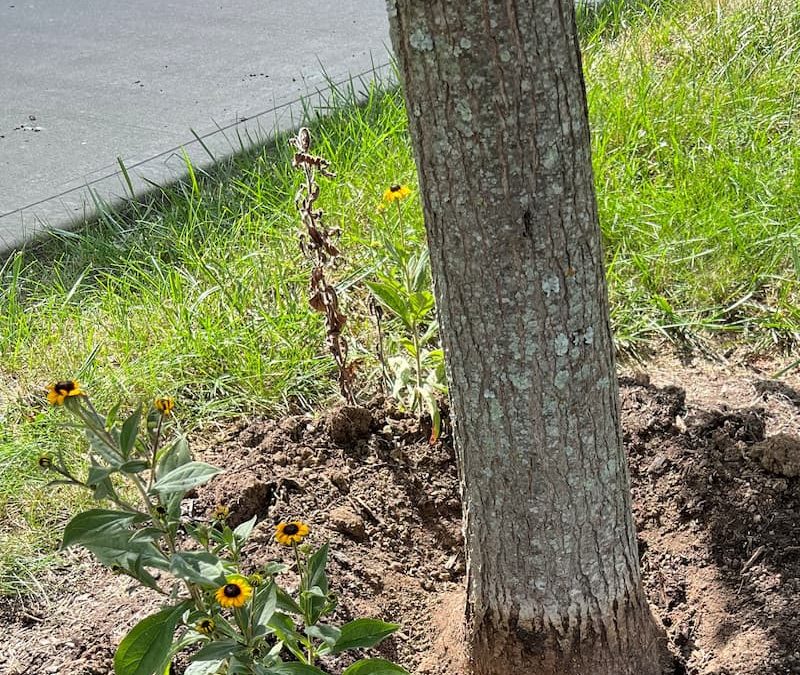
April showers…and mulch volcanoes?
Spring is the time for sprucing up the landscapes. Homeowners, excited for the warmer temperatures, enjoy getting their foundation plantings and trees mulched each year because it simply looks good. Many homeowners rely on their landscaper or lawn maintenance/mower/provider to supply and apply mulch. But do the lawncare and landscape technicians really understand proper tree care standards? Are landscapers and arborists the same?
Arborists focus on proper tree care with the goal of a healthy, structurally sound, long-lived, and valuable asset to their customers’ property.
We can refer to the dreaded MULCH VOLCANO when examining the differences between a landscaper and an arborist. In the spring, landscapers routinely add several inches of new mulch around trees and landscape plantings without removing any “old” mulch.
Problems caused by improper mulching (over 2 to 4” deep):
- Thick mulch becomes matted. It will begin to ferment and becomes an impervious barrier, depriving the soil and tree roots of oxygen and nutrients.
- Tree trunk bark and tissue will become softened and susceptible to disease and insect problems when mulch is piled against it.
- Too much mulch on newly installed or young trees’ roots may grow upward and encircle (girdle) the trunk. If these roots grow large enough, they potentially will injure the trunk and cause tree failure.
For the health of your trees and landscape plants, mulch should be applied near the trunk, but not touching it, and extend to the drip line of the tree. To prevent mulch buildup, old or faded mulch should be removed prior to new mulch to maintain the proper overall depth. In general, a 3’ radius ring of organic mulch, less than 4” deep is the minimum for most trees. Mulch with a compatible pH should be used on sensitive plants or those requiring a particular pH.
Mulching is beneficial when applied and maintained properly. The correct amount of mulch will minimize soil moisture loss and control weed germination. Mulch, as it decomposes, improves the soil fertility, biology, and structure. Mulch rings around trees protects trees from lawn mower and string trimmer damage.
Urban landscapes and especially new developments often have poor-quality soil with a reduced amount of organic matter. Mulch will, overtime, breakdown and provide some additional nutrients to improve the soil and support the tree.
More information about mulching and tree health can be found:
Chapter 9: Tree Health Care and Pruning – Tree Steward Manual
TreesAreGood Consumer Brochures Proper Mulching Techniques
http://cru.cahe.wsu.edu/CEPublications/FS160E/FS160E.pdf
Phone: 859-250-7475